


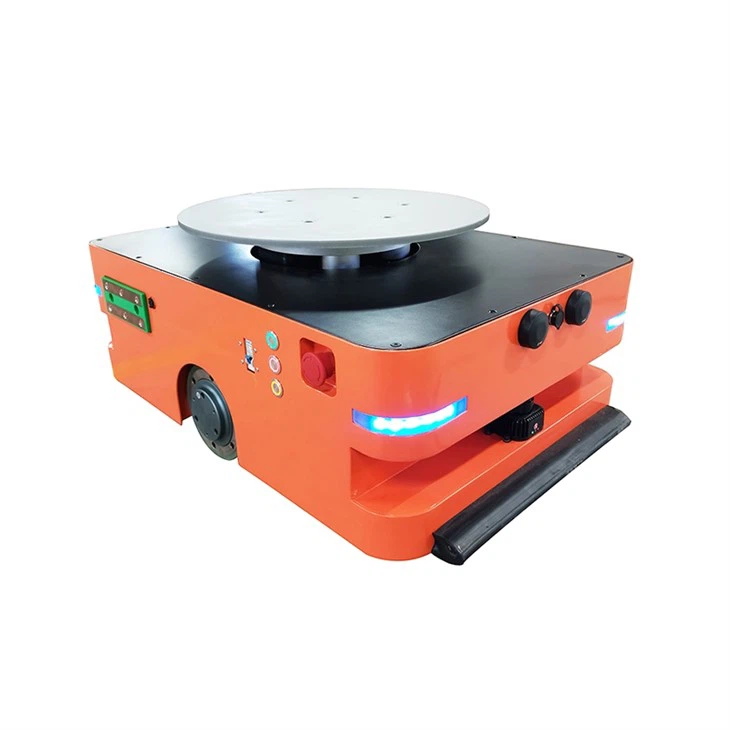
In the current field of intelligent robots, the manufacturing industry with AGV handling robots as the main body reflects the development requirements of intelligence, digitization and networking. Modern industrial robots have developed from mechanical arms with single functions and only certain fixed actions to multi-functional, multi-tasking programmable and highly flexible intelligent robots. Although the individual industrial robots in the system are flexible and programmable, most of the fixed automated production systems currently used are less flexible and suitable for long-term, large-scale production of single products, but difficult to adapt to the flexible, intelligent and highly integrated modern intelligent manufacturing model. In response to the development needs of intelligent manufacturing, the future industrial robot system has the following development trends:
1. Integrated development trend
Integration is the future development trend of industrial robots. The AGV handling robot can be designed with multi-functional integration to enable it to have the ability to perform multi-process processing, optimize the production links, and realize the integration of measurement, operation and processing. It can reduce the cumulative error in the production process, greatly improve the production efficiency and automation level of the production line, reduce the time cost and transportation cost in manufacturing, and is suitable for the integrated intelligent manufacturing model.
2. Development trend of intelligent information technology
In the future, the intelligent manufacturing model of digital factories with "Internet + robots" as the core will become the development direction of the manufacturing industry. It truly realizes the perfect integration of robots, the Internet, information technology and intelligent equipment in the manufacturing industry, covering the production, quality, logistics and other links of factory manufacturing, and is a typical representative of intelligent manufacturing. Combining related technologies such as industrial Internet technology, machine vision technology, human-computer interaction technology and intelligent control algorithm, AGV handling robots can quickly obtain processing information, accurately identify and locate operating targets, eliminate interference from factory environment and the diversity of operating target size and shape, realize multi-robot intelligent collaborative production, and meet the diversified and refined needs of intelligent manufacturing.
3. Flexible development trend
The modern intelligent manufacturing model puts forward flexible requirements for AGV handling robot systems. By developing an open control system for AGV handling robots, it is made expandable and portable; at the same time, the modular and reconfigurable mechanical structure of AGV handling robots is designed and manufactured, such as the integration of servo motors, reducers and detection systems in joint modules, so that the production workshop can expand or combine system modules according to the needs of production and manufacturing, improve the flexibility of the production line, and have the ability to complete various small-batch and customized production tasks.
4. Development trend of human-machine/multi-machine collaboration
In view of the current problems of industrial robots, such as insufficient operational flexibility, weak online perception and real-time operation capabilities, human-machine/multi-machine collaboration is the future development trend. By developing key technologies such as robot multimodal perception, environmental modeling, and optimized decision-making, the human-machine interaction experience and human-machine collaboration efficiency can be enhanced, and the advantages of robots and humans in perception, understanding, decision-making, etc. can be complemented, which can effectively improve the complex operation capabilities of AGV handling robots. At the same time, by developing multi-machine collaboration technology for AGV handling robots, distributed collaborative control of group robots can be realized. Its collaborative work ability improves the execution efficiency of tasks, and its redundant characteristics improve the robustness of task applications, and can complete various high-difficulty, high-precision and distributed tasks that cannot be completed by a single system.
5. Development trend of large-scale operations
Modern flexible manufacturing systems have put forward high requirements for the efficiency, reliability and adaptability of logistics, transportation, production operations and other links. In a working environment that requires large-scale operations, it is difficult for industrial robots with fixed bases to complete work tasks. By introducing mobile robot technology, the working space of AGV handling robots is effectively increased and the dexterity of robots is improved.