

In the rapidly evolving landscape of industrial automation, Automated Guided Vehicle (AGV) Robot have emerged as a game - changer. As an AGV Vehicle Robot supplier, I've witnessed firsthand the transformative impact these machines can have on businesses. One of the most pressing questions that clients often pose is about the return on investment (ROI) of an AGV Vehicle Robot. In this blog, I will delve into the various aspects of calculating the ROI of an AGV Vehicle Robot, exploring both the costs and benefits.

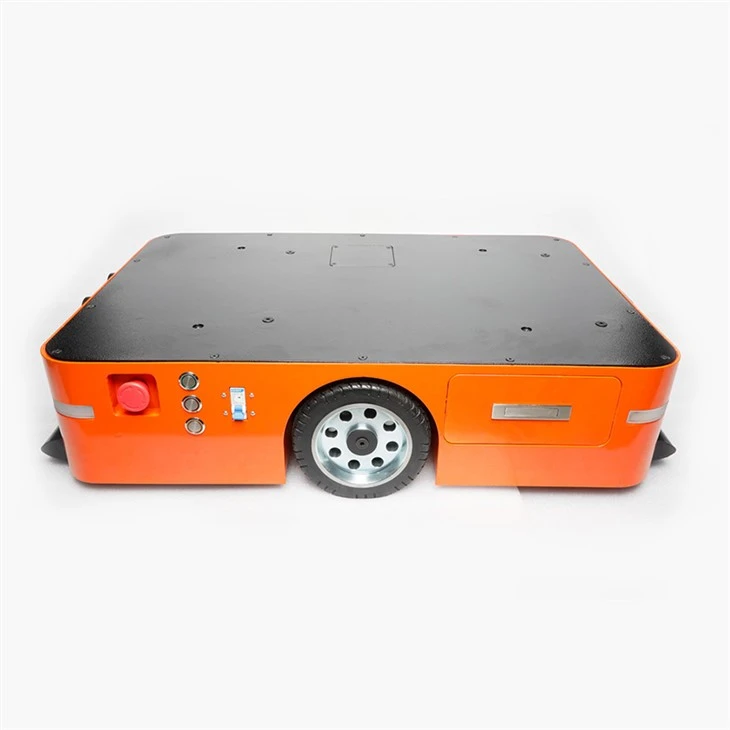
Initial Investment Costs
The first step in understanding the ROI of an AGV Vehicle Robot is to look at the initial investment. The cost of an AGV Vehicle Robot can vary significantly depending on several factors. These include the type of AGV (such as Auto Guided Transport Vehicle), its payload capacity, navigation technology, and additional features.
For instance, a basic AGV with a low payload capacity and simple navigation may cost in the range of $20,000 - $50,000. On the other hand, a high - end Mobile Robot AGV with advanced sensors, high payload capacity, and sophisticated navigation systems can cost upwards of $100,000.
In addition to the cost of the AGV itself, there are other associated costs. Installation and integration into the existing production or warehouse environment can be a significant expense. This may involve modifying the facility layout, installing charging stations, and integrating the AGV with the company's management systems. Training employees to operate and maintain the AGV is also a cost that needs to be factored in.
Operational Costs
Once the AGV is up and running, there are ongoing operational costs. Energy consumption is one of the primary operational expenses. AGVs typically run on batteries, and the cost of charging these batteries needs to be considered. However, compared to traditional material handling equipment, AGVs are often more energy - efficient, which can result in long - term savings.
Maintenance is another important operational cost. Regular maintenance is required to ensure the AGV operates smoothly and safely. This includes tasks such as battery replacement, sensor calibration, and software updates. The frequency and cost of maintenance will depend on the type of AGV and its usage.
Benefits of AGV Vehicle Robots
Increased Productivity
One of the most significant benefits of AGV Vehicle Robots is the increase in productivity. AGVs can operate 24/7 without breaks, unlike human workers. They can perform repetitive tasks with high precision and consistency, which reduces the time taken to complete tasks. For example, in a warehouse, AGVs can transport goods from one location to another much faster than manual labor, leading to a significant reduction in order fulfillment time.
Improved Safety
Safety is a major concern in industrial environments. AGV Vehicle Robots are equipped with advanced safety features such as collision detection sensors and emergency stop buttons. They can operate in hazardous areas, reducing the risk of accidents and injuries to human workers. This not only protects the well - being of employees but also reduces the potential for costly workplace accidents and associated legal liabilities.
Cost Savings in Labor
By automating material handling tasks, AGV Vehicle Robots can reduce the need for manual labor. This can lead to significant cost savings in terms of wages, benefits, and training. In addition, as labor costs continue to rise in many regions, investing in AGVs can provide a long - term solution to labor shortages and high labor costs.
Flexibility and Scalability
AGV Vehicle Robots offer a high degree of flexibility. They can be easily reprogrammed to perform different tasks or operate in different areas of a facility. This makes them suitable for a wide range of industries and applications. Moreover, as a business grows, additional AGVs can be added to the fleet, providing scalability without the need for major infrastructure changes.
Calculating the ROI
To calculate the ROI of an AGV Vehicle Robot, we need to consider both the costs and benefits over a specific period, usually several years. The formula for ROI is:
[ROI=\frac{Net;Benefits}{Initial;Investment}\times100%]
Net benefits are calculated by subtracting the total costs (initial investment + operational costs) from the total benefits (increased productivity, cost savings in labor, etc.) over the period of analysis.
For example, let's assume a company invests $100,000 in an AGV Vehicle Robot. Over a period of 5 years, the total operational costs (including energy, maintenance, and training) amount to $50,000. The company estimates that the AGV will result in labor cost savings of $30,000 per year and increased productivity worth $20,000 per year.
The total benefits over 5 years are ((30000 + 20000)\times5=$250,000). The total costs are (100000 + 50000=$150,000).
The net benefits are (250000 - 150000=$100,000).
The ROI is (\frac{100000}{100000}\times100% = 100%) over 5 years.
Long - Term Considerations
When evaluating the ROI of an AGV Vehicle Robot, it's important to consider the long - term implications. As technology continues to advance, AGVs are likely to become more efficient, with lower energy consumption and longer battery life. This can further improve the ROI over time.
In addition, as a company's business grows and changes, the AGV can be easily adapted to new requirements. This means that the initial investment in an AGV can provide long - term value and support the company's growth strategy.
Conclusion
The return on investment of an AGV Vehicle Robot is a complex calculation that takes into account both the initial investment and the long - term benefits. While the upfront cost of an AGV may seem high, the potential for increased productivity, improved safety, and cost savings in labor make it a worthwhile investment for many businesses.
If you're considering investing in an AGV Vehicle Robot for your business, I encourage you to reach out to us for a detailed consultation. We can help you assess your specific needs, calculate the potential ROI, and choose the right AGV solution for your operations. Let's work together to take your business to the next level of efficiency and productivity.
References
- Industry reports on AGV technology and market trends.
- Case studies of companies that have implemented AGV Vehicle Robots.
- Technical specifications and research on AGV performance and cost - effectiveness.