

Hey there! As an AGV chassis supplier, I often get asked about how our AGV chassis communicate with other AGVs. It's a fascinating topic, and I'm excited to share some insights with you.
First off, let's understand the importance of communication among AGVs. In a warehouse or industrial setting, multiple AGVs are usually working together. They need to share information about their positions, tasks, and the status of the routes they're on. This communication is crucial for efficient operation, avoiding collisions, and ensuring that all tasks are completed in a timely manner.
There are several ways our AGV chassis can communicate with other AGVs, and I'll break them down for you.
Wireless Communication Protocols
One of the most common methods is through wireless communication protocols. Wi - Fi is a popular choice. It's widely available and easy to set up. Our AGV chassis can be equipped with Wi - Fi modules that allow them to connect to a local network. Once connected, they can exchange data with other AGVs on the same network. For example, an AGV can send a message to others saying it's about to enter a narrow aisle, so the other AGVs can plan their routes accordingly.
Bluetooth is another option. It's great for short - range communication. If two AGVs are in close proximity, say when they're at a loading dock, they can use Bluetooth to quickly exchange data. This could be information about the load they're carrying or the next task they're assigned to.

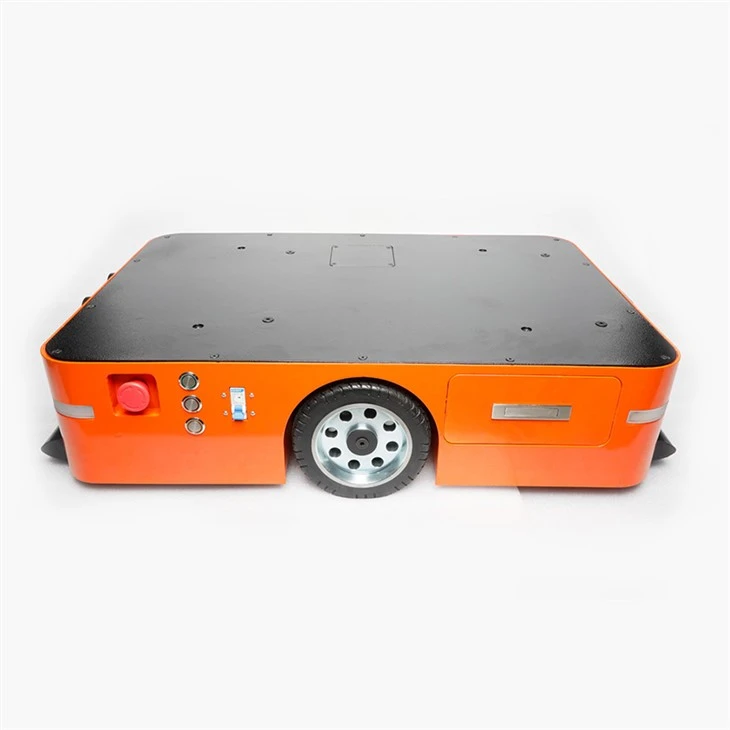
ZigBee is also used in some cases. It's a low - power, low - data - rate wireless protocol. It's suitable for AGV communication because it can operate in a mesh network. This means that AGVs can relay messages to each other, even if they're not directly connected. For instance, if an AGV at the far end of the warehouse needs to send a message to the control center, it can pass the message through other AGVs in a chain until it reaches its destination.
Radio Frequency (RF) Communication
RF communication is also a reliable way for our AGV chassis to talk to other AGVs. We can use specific RF frequencies that are dedicated to industrial use. This method offers a good balance between range and data transfer speed. The AGV chassis can be fitted with RF transceivers. These transceivers can send and receive signals over a certain distance. For example, in a large outdoor yard where AGVs are moving containers, RF communication can ensure that the AGVs stay in touch with each other and the central control system.
Infrared Communication
Infrared communication is often used for line - of - sight communication. Our AGV chassis can be equipped with infrared sensors. When two AGVs are facing each other, they can use infrared signals to exchange data. This is useful in situations where the AGVs need to synchronize their actions, like when they're working together to lift a large object. However, the range of infrared communication is limited, and it can be affected by obstacles and ambient light.
Centralized Control System
In addition to direct communication between AGVs, we also rely on a centralized control system. This system acts as a coordinator for all the AGVs in the area. Our AGV chassis are designed to connect to this central system. They send data about their status, such as their current location, battery level, and the task they're performing. The central system then processes this information and sends out instructions to the AGVs. For example, if there's a sudden change in the production schedule, the central system can quickly re - assign tasks to the AGVs.
Data Formats and Standards
When our AGV chassis communicate, they need to use a common data format. There are several industry standards for this. For example, the ISO 11783 standard is widely used in the agricultural and industrial automation sectors. It defines how data should be structured and transmitted between different types of equipment, including AGVs. By following these standards, our AGV chassis can communicate seamlessly with other AGVs, regardless of the manufacturer.
The Role of Software
Software plays a vital role in AGV communication. Our AGV chassis come with onboard software that manages the communication process. This software is responsible for sending and receiving messages, interpreting the data, and making decisions based on that data. For example, if an AGV receives a message saying there's an obstacle on its planned route, the software can quickly recalculate a new route.
Now, let's talk about some real - world applications. In a distribution center, our AGV chassis are used in Mobile Robot AGV Mobile Robot AGV. These AGVs work together to move products from the storage area to the shipping area. Through constant communication, they ensure that the products are delivered on time and without any collisions.
In a manufacturing plant, the AGV Vehicle Robot AGV Vehicle Robot with our chassis are used to transport raw materials and finished products. The communication between the AGVs helps in optimizing the production process. For example, if a machine is running low on a particular raw material, an AGV can be quickly dispatched to bring more.
Auto Steered Material Transport Vehicle Auto Steered Material Transport Vehicle also benefit from the communication capabilities of our AGV chassis. These vehicles operate in large warehouses and yards, and they need to coordinate their movements to avoid congestion.
If you're in the market for high - quality AGV chassis that offer excellent communication capabilities, we're here to help. Whether you're running a small - scale operation or a large industrial facility, our AGV chassis can meet your needs. We can provide customized solutions based on your specific requirements. So, if you're interested in learning more or starting a procurement discussion, don't hesitate to reach out. We're looking forward to working with you to make your AGV operations more efficient and productive.
References
- ISO 11783 standard documentation
- Industry research papers on AGV communication technologies